Wednesday, March 19, 2008

Why I Changed My Mind


The bumper of my car sports a John Edwards sticker. I haven't been able to bring myself to peel it off, because I had so looked forward to voting for Sen Edwards for president.

Until he bowed out of the race, I was fond of saying that I couldn't believe that there was a woman running for president, a woman I admire, with a real chance of winning, and I was supporting the white guy. But I really believed that Edwards was best for the country, and he was my guy.

Since he bowed out, I've been supporting Senator Clinton. I didn't trust Senator Obama's youth, his shorter time in government, but mostly I didn't trust all that talk about "change." It seemed to me that in every other election, we've got someone talking about "change" and then what we get, if we elect that person, is a mess of some kind. I voted for Bill Clinton because he represented change but what we got was eight years of the Arkansas mafia gunning for him, with the Republicans gleefully cheering them on. I remember people voting for Jimmy Carter, because he represented a change, and the Carter years were a wreck, reaping the various whirlwinds sown years before.

So I was skeptical about "change." I felt like I was too smart to fall for that again, and I felt rather sad for the young people I saw who were all excited about it. Here we go again, I thought, and wished they'd support Senator Clinton. Also, I hated the way the press and the public has accepted the misogyny directed at her; it seemed to me that it had become acceptable to be publicly misogynist, when it was at least not acceptable to be publicly racist. I identified with Clinton; she grew on me.

Then today I read Senator Obama's remarkable speech on race. I heard on NPR that this wasn't the product of a speechwriter, either: he wrote it himself. It is a risky, gutsy, honest, sophisticated speech (how's that for an interesting string of adjectives?) I would love to see this country engage honestly with the issue of race. I would love to see us all admit that we're suspicious of each other, but that we want our lives to be better than they are. I would love to see the lively discussion that Obama calls for; I would love to participate in it. I cannot imagine a better antidote to the Bush Presidencies Part Deux and their damage to our international standing than this intelligent, honest man with the very un-WASPy name.

I'm still rather skeptical about "change" as the theme for a campaign, but that's because I'm cranky and jaded and my move into political adulthood coincided with Watergate, Gerald Ford, and Jimmy Carter. But I am enthusiastic about voting for a wise and well-educated person of courage, and that's what I see in Barack Obama.

I don't know how much "change" he can really pull off. But I'd love for him to have the chance to try.

Friday, March 14, 2008

St. Patrick's Day

There's an interesting op-ed piece in today's NY Times about Irish-American heritage. Online, it's followed by an even more interesting argument, in bulletin-board form, about all sorts of related issues: Irish vs.Irish-American identity, the relevance of the Great Hunger, the Celtic Tiger, and more.

When I was an Irish-American kid in Catholic school, the main thing on St. Patrick's Day was to remember to wear green so you didn't get pinched. I remember asking my grandmother about it, she who went to great lengths to impress the family's Irish heritage on me. I was surprised to find that she didn't have much use for St. Patrick's Day. St. Patrick himself was fine -- she was down with most saints -- but the American celebration seemed to her to be an opportunity for Irish-Americans to make themselves appear to be superstitious, drunk, and harmless. She wasn't interested in leprechauns; she wanted me to appreciate a great heritage of scholarship, poetry, and toughness. Specifically, she drilled it into me that our ancestors had had to be tough, simply to survive to come to America. Peter and Bridget Carroll nearly died on the coffin ship, and were so anxious to put it behind them that the family forgot the its name. She told me they were from County Roscommon, that they had survived a great disaster, and that when they got here, all they wanted was to have a farm of their own. Peter worked on the railroad, and Bridget made lace, and they traveled with the railroad until they had enough money to buy a rocky little "holler" in Dickson County, Tennessee. They lived there all the rest of their lives and are buried there today. They were not wanted in America, and they came anyway. They spoke Irish, as did their children, and by my grandmother's generation, it had become a weird little private language that was spoken by no one except the Carrolls and Cunniffs of Dickson County Tennessee.

The Civil War was not their war, as far as they were concerned, and they stayed clear of it. Living in the battlefield of Middle Tennessee, they fought their own war ingeniously: every time an army came through, Peter and the boys would hide in the root cellar, and Bridget and the other women would go to the door and try to convey that their men were off with That army -- Confederate, if it was Rebels at the door, and Union, if it was Yankees. It was not their war, and they wanted no part of it. They survived.

My grandmother's memory inspired me to take a course in Irish History in College, and to keep reading ever since. The best book, though, is out of print: Harp, by John Gregory Dunne. It made sense, for me, of some of the tensions in family life that I hadn't realized were also a legacy from the dark entry our ancestors made to the Promised Land of the United States.

I am sad that so many Irish Americans are ignorant about our history. I would like for some of my cousins (the ones with names like Hannity or Limbaugh) to remember that there was a time when our great-great-grandparents were not welcome here. Did we learn nothing?

I'm proud to be Irish-American. I still feel like JFK is "my" president, in a way that none before or since ever have been. I notice names that might be Irish, and I follow Ireland in the news. But if you want to buy me a beer on March 17, make it a proper Guinness, not that silly green stuff.

Wednesday, February 27, 2008

It's done.

I am sitting at my kitchen table right now, listening to the printer clatter out one page at a time on the "Best" setting. My thesis is done, and I'm printing out the two copies I need to deposit with the school registrar, with my advisor's signature.

"Money & Menschlikeit: A Jewish Ethics of Personal Finance" has taken me most of a year to write. At the moment, I have no profound thoughts. I just want it to finish printing so I can get a few hours of sleep before I have to meet Dr. Adler at 10:30 a.m. Maybe I'll have profound thoughts tomorrow. Or maybe I've used up all my profound thoughts writing the thing. I have no idea.

One of the people who has known me longest, Jim Scott (my ex-father-in-law, not my son) said to me a few months ago, "You've been working on this subject all your life." That's true. I don't have all the answers now, but I've got some dandy questions.

Friday, February 22, 2008

I'm angry.

Salon.com published an article this week entitled The Gay Marriage Slump.
It's a rather vapid little piece wondering why, after all the fuss about "gay marriage" gay couples aren't storming the courthouses to register as domestic partners in states that allow it. (Notice that word, "allow." Says a lot. Harumph.)

This was my letter in response:

"Why we aren't registered"

My partner and I have chosen to get married in a religious ceremony, but not to register as domestic partners here in California. Our reason? The Registered Domestic Partner thing is NOT the equivalent of a civil marriage. If we register, we get to file the nightmare tax returns that another letter writer mentioned (one set for the state, jointly, and another set for the feds, individually). We get "marriage taxed" by the state, but we still don't get a lot of the rights of married people.

Add to that that my partner is a retired federal employee. Thirty plus years in the U.S. Navy and in federal law enforcement, and I'm ineligible for her health insurance and any other benefits a REAL spouse would receive.

Why would we pay extra taxes, when we get fewer rights? Forget that!

We've married in the eyes of our religious community. We're together until death do us part. But I will not cooperate in the government's marginalizing of our lives, and I sure as heck will not pay taxes for "rights" I am denied.


_______________________

Why post this letter again here? Because I realize I'm really angry about this. I'm tired of being a second-class citizen. I'm sick of people imposing their religious views or (let's call it what it is) their bigotries upon me and my beloved.

I pay taxes. I am married to a woman who spent her entire adult life serving her country. Yet we do not get the same rights that any straight couple who go to Vegas for the weekend can have simply by saying "I do."

I am a Jew. I don't eat pork because I believe I am commanded not to eat pork. I don't insist on a law that won't let anyone eat pork just because I think the Bible says "Don't eat pork." Meditate on that, the next time you chow down on a pulled pork sandwich or shrimp cocktail -- I am not imposing my religious beliefs on you. Don't impose yours on me.

It's called the separation of church and state, folks.

Monday, December 10, 2007

I got some interesting feedback from that last post -- seems that folks think that they'd be interested my study projects.

So here we go, rather late in the process, but what the heck:

1. I'm working on a paper about the Vow of Jephthah (Judges 11). I think that the response of Jephthah's daughter may hold some promise for adult women who have a history as victims of child sexual abuse (putting that very carefully -- some identify as "survivors," some prefer other designations). Tradition holds up role models for obedient children, but not so much for those who have been betrayed by those they should have been able to trust. (Yes, Tamar is a wronged woman who stands up for herself, but she's an adult, and the wrong is quite different.)

2. My thesis is driving me crazy. I'm working on an ethics of personal finance, which ought to be very straightforward, but some of my own emotional responses to it, mixed up with some emotional responses to other events in my life have complicated things. It's frustrating, and approaching a crisis, frankly, because I need to produce something deliverable pretty soon.

Saturday, December 08, 2007

It's been a long time since my last post - I don't know if anyone is still reading here or not.

I enjoyed blogging during my year in Jerusalem; it seemed like a good way to reassure the people I love and make a record of the year at the same time. Then, when I got back to L.A., it was still about keeping in touch.

Trouble is, most of what I do is work and study. I love what I study, but I wasn't sure it would make for exactly interesting reading, especially when it was mostly questions. And work more and more involved things that didn't belong in a blog, so there just wasn't much to say.

I love my work. That came back to me last night, as I presided over a Chanukah potluck and Shabbat for my current congregational pulpit. I'm just a bi-monthly rabbinical intern; I officiate at a Friday night service twice a month, more or less, and when there are lifecycle events I do those. If someone is in the hospital, I visit.

Last night was my first night back after a gap, since my father died and I had to miss the late October service, and then for a variety of reasons, there was no November service. I arrived feeling tired and blue, under the weather with a bit of a cold. Once we got to the potluck part of the evening, I circulated from table to table, reconnecting with people, checking in, finding out who had had minor surgery (why didn't you let me know you were in the hospital??? Call next time!) and who was having some family troubles (let's make an appointment to talk, here's my email) and who had had a great trip to Israel and who has finals this month and ... you get the idea.

By the time I finished my rounds, something in me had shifted. I'd been feeling blue and tired because my thesis is driving me crazy and the mourning after my father's death has been difficult. After a few hours of leading prayers and listening and checking in and rabbi-ing, I was back in touch with the work I love.

This is a really peculiar job. A lot of it is just showing up: being present to the moment, looking in people's eyes, listening, tapping into the tradition and texts I have learned when that's what they need. Showing up: reading the service at the burial of a woman who has no family left to bury her. Some of it has to do with orienting a Jewish frame for people's ordinary lives and decisions. Most of it is not about great scholarship or great leadership or great anything, just calm presence and occasionally, a nudge in a new direction. God-talk is not comfortable for many liberal Jews; I'm going to accomplish more by living out the Divine Attributes than I am talking about them.

"Adonai, Adonai, El, Rachum v'Chanun erech Apayim v'Rov Chesed, v'Emet, Notzer chesed l'alafim, Nosseh avon v'feshah, v'chatta'ah, v'Nakeh." (Exodus 34:6-7)

[TheName, TheName, God, Merciful and Gracious, Slow to Anger and Abundant in Kindness and Truth, Preserver of Kindness for thousands of generations, Forgiver of iniquity, of willful sin, and of mistakes, and the One who Purifies.]

Yes, there are times and places for a prophetic voice, and I can afflict the comfortable when that is called for, but I have to admit, I find the ordinary round very satisfying. I love my work.

Monday, September 03, 2007


When people ask me where I'm "from," I always pause for a moment, because it could mean a lot of things.

I still have a mild Southern accent, even after 21 years on the West Coast, and sometimes the question is really, "Is that Tennessee or Texas that I hear?" It annoys me when people assume I am from Texas. I have never mis-pronounced "nuclear" as "nukular" in my life, not once. If that's the question, then I say I'm from Williamson County, Tennessee. If I say "Brentwood, TN" then they say, "Oh, Nashville," but when I was a kid, Brentwood was not a suburb. Brentwood was barely a post office when they brought me home from the hospital in 1955, and Nashville was another world.

Even if they are not asking about the accent, questions remain. Most nights I sleep in an apartment in Marina del Rey, CA., one of the many little towns that Los Angeles ate sometime in the last century. It is not really "home," however; it is where I sleep most nights, because Hebrew Union College is too long a commute from Oakland.

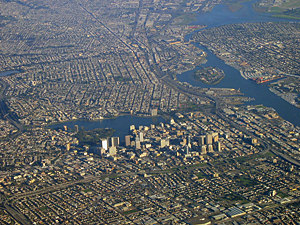
My heart is up in Oakland, CA, although it's hard to put a specific address on it. Linda has a home on the San Leandro border where I am found whenever I get a chance to go north, but I've never really lived in it. The homes where I lived in Oakland now belong to other people. My sons live and work in Oakland. Temple Sinai, my Jewish home, is still in Oakland. Many of my dearest friends are there. Most of these things and people are somewhere near Lake Merritt, which was the first place in Oakland that felt like home to me: I drove off the Grand Lake Exit from I-580, lost, looked around me, and loved the place.

Every weekend that I travel up there, I get to see it from the air if the clouds cooperate. The view from Southwest Airlines is beautiful: I see the lake, and the neighborhoods around, and it always makes me happy.