I am sitting at my kitchen table right now, listening to the printer clatter out one page at a time on the "Best" setting. My thesis is done, and I'm printing out the two copies I need to deposit with the school registrar, with my advisor's signature.
"Money & Menschlikeit: A Jewish Ethics of Personal Finance" has taken me most of a year to write. At the moment, I have no profound thoughts. I just want it to finish printing so I can get a few hours of sleep before I have to meet Dr. Adler at 10:30 a.m. Maybe I'll have profound thoughts tomorrow. Or maybe I've used up all my profound thoughts writing the thing. I have no idea.
One of the people who has known me longest, Jim Scott (my ex-father-in-law, not my son) said to me a few months ago, "You've been working on this subject all your life." That's true. I don't have all the answers now, but I've got some dandy questions.
Wednesday, February 27, 2008


Friday, February 22, 2008
I'm angry.
Salon.com published an article this week entitled The Gay Marriage Slump.
It's a rather vapid little piece wondering why, after all the fuss about "gay marriage" gay couples aren't storming the courthouses to register as domestic partners in states that allow it. (Notice that word, "allow." Says a lot. Harumph.)
This was my letter in response:
"Why we aren't registered"
_______________________
Why post this letter again here? Because I realize I'm really angry about this. I'm tired of being a second-class citizen. I'm sick of people imposing their religious views or (let's call it what it is) their bigotries upon me and my beloved.
I pay taxes. I am married to a woman who spent her entire adult life serving her country. Yet we do not get the same rights that any straight couple who go to Vegas for the weekend can have simply by saying "I do."
I am a Jew. I don't eat pork because I believe I am commanded not to eat pork. I don't insist on a law that won't let anyone eat pork just because I think the Bible says "Don't eat pork." Meditate on that, the next time you chow down on a pulled pork sandwich or shrimp cocktail -- I am not imposing my religious beliefs on you. Don't impose yours on me.
It's called the separation of church and state, folks.
It's a rather vapid little piece wondering why, after all the fuss about "gay marriage" gay couples aren't storming the courthouses to register as domestic partners in states that allow it. (Notice that word, "allow." Says a lot. Harumph.)
This was my letter in response:
"Why we aren't registered"
My partner and I have chosen to get married in a religious ceremony, but not to register as domestic partners here in California. Our reason? The Registered Domestic Partner thing is NOT the equivalent of a civil marriage. If we register, we get to file the nightmare tax returns that another letter writer mentioned (one set for the state, jointly, and another set for the feds, individually). We get "marriage taxed" by the state, but we still don't get a lot of the rights of married people.
Add to that that my partner is a retired federal employee. Thirty plus years in the U.S. Navy and in federal law enforcement, and I'm ineligible for her health insurance and any other benefits a REAL spouse would receive.
Why would we pay extra taxes, when we get fewer rights? Forget that!
We've married in the eyes of our religious community. We're together until death do us part. But I will not cooperate in the government's marginalizing of our lives, and I sure as heck will not pay taxes for "rights" I am denied.
_______________________
Why post this letter again here? Because I realize I'm really angry about this. I'm tired of being a second-class citizen. I'm sick of people imposing their religious views or (let's call it what it is) their bigotries upon me and my beloved.
I pay taxes. I am married to a woman who spent her entire adult life serving her country. Yet we do not get the same rights that any straight couple who go to Vegas for the weekend can have simply by saying "I do."
I am a Jew. I don't eat pork because I believe I am commanded not to eat pork. I don't insist on a law that won't let anyone eat pork just because I think the Bible says "Don't eat pork." Meditate on that, the next time you chow down on a pulled pork sandwich or shrimp cocktail -- I am not imposing my religious beliefs on you. Don't impose yours on me.
It's called the separation of church and state, folks.
Monday, December 10, 2007
I got some interesting feedback from that last post -- seems that folks think that they'd be interested my study projects.
So here we go, rather late in the process, but what the heck:
1. I'm working on a paper about the Vow of Jephthah (Judges 11). I think that the response of Jephthah's daughter may hold some promise for adult women who have a history as victims of child sexual abuse (putting that very carefully -- some identify as "survivors," some prefer other designations). Tradition holds up role models for obedient children, but not so much for those who have been betrayed by those they should have been able to trust. (Yes, Tamar is a wronged woman who stands up for herself, but she's an adult, and the wrong is quite different.)
2. My thesis is driving me crazy. I'm working on an ethics of personal finance, which ought to be very straightforward, but some of my own emotional responses to it, mixed up with some emotional responses to other events in my life have complicated things. It's frustrating, and approaching a crisis, frankly, because I need to produce something deliverable pretty soon.
So here we go, rather late in the process, but what the heck:
1. I'm working on a paper about the Vow of Jephthah (Judges 11). I think that the response of Jephthah's daughter may hold some promise for adult women who have a history as victims of child sexual abuse (putting that very carefully -- some identify as "survivors," some prefer other designations). Tradition holds up role models for obedient children, but not so much for those who have been betrayed by those they should have been able to trust. (Yes, Tamar is a wronged woman who stands up for herself, but she's an adult, and the wrong is quite different.)
2. My thesis is driving me crazy. I'm working on an ethics of personal finance, which ought to be very straightforward, but some of my own emotional responses to it, mixed up with some emotional responses to other events in my life have complicated things. It's frustrating, and approaching a crisis, frankly, because I need to produce something deliverable pretty soon.
Saturday, December 08, 2007
It's been a long time since my last post - I don't know if anyone is still reading here or not.
I enjoyed blogging during my year in Jerusalem; it seemed like a good way to reassure the people I love and make a record of the year at the same time. Then, when I got back to L.A., it was still about keeping in touch.
Trouble is, most of what I do is work and study. I love what I study, but I wasn't sure it would make for exactly interesting reading, especially when it was mostly questions. And work more and more involved things that didn't belong in a blog, so there just wasn't much to say.
I love my work. That came back to me last night, as I presided over a Chanukah potluck and Shabbat for my current congregational pulpit. I'm just a bi-monthly rabbinical intern; I officiate at a Friday night service twice a month, more or less, and when there are lifecycle events I do those. If someone is in the hospital, I visit.
Last night was my first night back after a gap, since my father died and I had to miss the late October service, and then for a variety of reasons, there was no November service. I arrived feeling tired and blue, under the weather with a bit of a cold. Once we got to the potluck part of the evening, I circulated from table to table, reconnecting with people, checking in, finding out who had had minor surgery (why didn't you let me know you were in the hospital??? Call next time!) and who was having some family troubles (let's make an appointment to talk, here's my email) and who had had a great trip to Israel and who has finals this month and ... you get the idea.
By the time I finished my rounds, something in me had shifted. I'd been feeling blue and tired because my thesis is driving me crazy and the mourning after my father's death has been difficult. After a few hours of leading prayers and listening and checking in and rabbi-ing, I was back in touch with the work I love.
This is a really peculiar job. A lot of it is just showing up: being present to the moment, looking in people's eyes, listening, tapping into the tradition and texts I have learned when that's what they need. Showing up: reading the service at the burial of a woman who has no family left to bury her. Some of it has to do with orienting a Jewish frame for people's ordinary lives and decisions. Most of it is not about great scholarship or great leadership or great anything, just calm presence and occasionally, a nudge in a new direction. God-talk is not comfortable for many liberal Jews; I'm going to accomplish more by living out the Divine Attributes than I am talking about them.
"Adonai, Adonai, El, Rachum v'Chanun erech Apayim v'Rov Chesed, v'Emet, Notzer chesed l'alafim, Nosseh avon v'feshah, v'chatta'ah, v'Nakeh." (Exodus 34:6-7)
[TheName, TheName, God, Merciful and Gracious, Slow to Anger and Abundant in Kindness and Truth, Preserver of Kindness for thousands of generations, Forgiver of iniquity, of willful sin, and of mistakes, and the One who Purifies.]
Yes, there are times and places for a prophetic voice, and I can afflict the comfortable when that is called for, but I have to admit, I find the ordinary round very satisfying. I love my work.
I enjoyed blogging during my year in Jerusalem; it seemed like a good way to reassure the people I love and make a record of the year at the same time. Then, when I got back to L.A., it was still about keeping in touch.
Trouble is, most of what I do is work and study. I love what I study, but I wasn't sure it would make for exactly interesting reading, especially when it was mostly questions. And work more and more involved things that didn't belong in a blog, so there just wasn't much to say.
I love my work. That came back to me last night, as I presided over a Chanukah potluck and Shabbat for my current congregational pulpit. I'm just a bi-monthly rabbinical intern; I officiate at a Friday night service twice a month, more or less, and when there are lifecycle events I do those. If someone is in the hospital, I visit.
Last night was my first night back after a gap, since my father died and I had to miss the late October service, and then for a variety of reasons, there was no November service. I arrived feeling tired and blue, under the weather with a bit of a cold. Once we got to the potluck part of the evening, I circulated from table to table, reconnecting with people, checking in, finding out who had had minor surgery (why didn't you let me know you were in the hospital??? Call next time!) and who was having some family troubles (let's make an appointment to talk, here's my email) and who had had a great trip to Israel and who has finals this month and ... you get the idea.
By the time I finished my rounds, something in me had shifted. I'd been feeling blue and tired because my thesis is driving me crazy and the mourning after my father's death has been difficult. After a few hours of leading prayers and listening and checking in and rabbi-ing, I was back in touch with the work I love.
This is a really peculiar job. A lot of it is just showing up: being present to the moment, looking in people's eyes, listening, tapping into the tradition and texts I have learned when that's what they need. Showing up: reading the service at the burial of a woman who has no family left to bury her. Some of it has to do with orienting a Jewish frame for people's ordinary lives and decisions. Most of it is not about great scholarship or great leadership or great anything, just calm presence and occasionally, a nudge in a new direction. God-talk is not comfortable for many liberal Jews; I'm going to accomplish more by living out the Divine Attributes than I am talking about them.
"Adonai, Adonai, El, Rachum v'Chanun erech Apayim v'Rov Chesed, v'Emet, Notzer chesed l'alafim, Nosseh avon v'feshah, v'chatta'ah, v'Nakeh." (Exodus 34:6-7)
[TheName, TheName, God, Merciful and Gracious, Slow to Anger and Abundant in Kindness and Truth, Preserver of Kindness for thousands of generations, Forgiver of iniquity, of willful sin, and of mistakes, and the One who Purifies.]
Yes, there are times and places for a prophetic voice, and I can afflict the comfortable when that is called for, but I have to admit, I find the ordinary round very satisfying. I love my work.
Monday, September 03, 2007
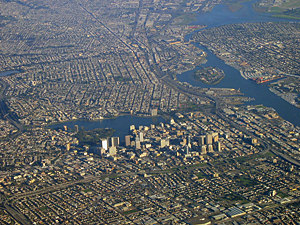
When people ask me where I'm "from," I always pause for a moment, because it could mean a lot of things.
I still have a mild Southern accent, even after 21 years on the West Coast, and sometimes the question is really, "Is that Tennessee or Texas that I hear?" It annoys me when people assume I am from Texas. I have never mis-pronounced "nuclear" as "nukular" in my life, not once. If that's the question, then I say I'm from Williamson County, Tennessee. If I say "Brentwood, TN" then they say, "Oh, Nashville," but when I was a kid, Brentwood was not a suburb. Brentwood was barely a post office when they brought me home from the hospital in 1955, and Nashville was another world.
Even if they are not asking about the accent, questions remain. Most nights I sleep in an apartment in Marina del Rey, CA., one of the many little towns that Los Angeles ate sometime in the last century. It is not really "home," however; it is where I sleep most nights, because Hebrew Union College is too long a commute from Oakland.
My heart is up in Oakland, CA, although it's hard to put a specific address on it. Linda has a home on the San Leandro border where I am found whenever I get a chance to go north, but I've never really lived in it. The homes where I lived in Oakland now belong to other people. My sons live and work in Oakland. Temple Sinai, my Jewish home, is still in Oakland. Many of my dearest friends are there. Most of these things and people are somewhere near Lake Merritt, which was the first place in Oakland that felt like home to me: I drove off the Grand Lake Exit from I-580, lost, looked around me, and loved the place.
Every weekend that I travel up there, I get to see it from the air if the clouds cooperate. The view from Southwest Airlines is beautiful: I see the lake, and the neighborhoods around, and it always makes me happy.
Monday, June 18, 2007
So, what did you do on summer vacation?

Linda Burnett and I were married in a little ceremony at Temple Sinai in Oakland, CA. The officiants were Rabbis Steven Chester and Jacqueline Mates-Muchin, and the witnesses for the brit ahuvot were Mark Snyder and Dawn Kepler.
Maryann Simpson helped us get organized and dressed, Rabbi David Novak led the sheva brachot at lunch, and guests joined us in giving tzedakah to the Alameda County Community Food Bank as a way of sharing the joy.
Family and close friends were with us, and celebrated afterwards at lunch. It was a great, great day.
 From our honeymoon:
THIS was the stop on the trip I had looked forward to the most: Piraeus, Athens, Corinth, and Mycenae. Those are magic words for me: I have loved the Iliad since I was about ten years old.
We arrived in Piraeus, the port city of Athens. Simply bobbing in the harbor there was exciting: this is the port from which the thousand ships launched (Helen's face? Iliad? Trojan War? right.) Nowadays it is full of ferries, freighters, and passenger ships, not triremes and other warships, but still. It didn't take much imagination to be all excited at the idea that this was the very place where Agamemnon sent Clytemnestra into a rage by sacrificing their daughter Iphigenia for a favorable wind.
 We had a favorable bus ("21 Purple") and anyway, we were headed inland. Our tour group was a motley crew, including a woman dressed like a ninja (I later found out she suffers from porphyria and cannot tolerate sunlight), several gimpy types like myself (we actually discussed knee replacements -- one woman had had TWO), a Gnostic priest and her honey, a very young couple in camouflage and khaki, and Linda with yours truly. Our tourguide's name was Georgia, and she stepped very gracefully among questions about everything from goddesses to bathroom locations.
 Driving out of Athens, we saw the Acropolis from a distance through smog that put L.A. to shame. Granted, it was a rainy, overcast day, but this was impressive smog. The photo I'm posting has been cropped, blown up, and seriously enhanced; I won't waste bandwidth with the original. Still, we can say we saw the Parthenon.
 We drove onwards to the next feature, the Corinth Canal. This is a modern wonder, and from an engineering point of view, it truly is a marvelous thing, even if from above it is basically an enormous ditch. It connects the Ionian and Aegean Seas, and makes the Peloponnesian Penninsula into an island. We stopped there and looked at it. We also found a bathroom there, which for a busload of women is another modern engineering marvel worth noting.
We rode for another long while, to intermittent commentary from Georgia about olive trees and ancient politics, until a mountain topped with ruins came into view. "Look up there," said Georgia, pointing. "That is the site of the Corinthian Temple of so-called Aphrodite." Seems the locals actually worshipped a version of the Middle Eastern fertility goddess Astarte, and called her Aphrodite to make it all nice. The Temple was, among other things, an enormous cult brothel, but looking at it, all I could think was that a man had to be awfully determined to get up there. Anything for piety, I suppose!
 That acropolis was one reason that Corinth got such a bad name in the ancient world. It was full of sailors and adventurers and cult prostitutes -- no wonder Paul of Tarsus, aka St. Paul, felt the need to lecture the inhabitants on the virtues of agape, or brotherly love! Judging from the ruins, it was also a lovely city. I'll post some photos so you can see what's left of the ancient agora [city center]. The acropolis was not accessible to us (45 min of hard climbing) but the agora was very accessible, and had a museum nearby of artifacts that are still being discovered as they excavate the city.
We made some interesting discoveries there. The city bema was the
 presidium the big platform on which public speaking was done. I've heard that, but I'd never seen a bema before, and there it is. It happens that this particular bema was the one on which Paul of Tarsus was examined by the Roman authorities after complaints from the local synagogue. We saw bits of the local of the Greek city assembly,synagogue, also: only two small pieces are identifiable, and they were recovered after reuse as parts of other buildings. There is a capital from a column in the museum that has menorot with etrog and lulav, which we spotted almost immediately. There is also an inscription that has the last three letters of the word "synagogue" in Greek along with the first four letters of "Hebrew." According to the guide, that's all that is left of it, and those parts had been recycled as building stone for other, more recent structures.
 We saw several bas relief sculptures of a battle between Amazons and Greeks, and beautiful sculptures. All in all, we could have stayed longer, and seen more, but it was time for Mycenae.
We drove some more, and that was when Georgia began to make ominous noises about Mycenae. "We will wait to eat lunch," she said, "It's a very big climb, not good after lunch." Those among us with orthopedic issues sat up and took notice. How much of a climb? Pretty good climb, she assured us. We looked around, and you could feel the resolve hardening in that bus: we'd come to see Agamemnon's city, and by golly, we were gonna see it!
 We drove on and on, and Georgia told us about the quarry the archaeologists have found, from which huge stones of the special composite stone were carved for the Lion Gate and the Tomb of Agamemnon. It's miles from Mycenae (since we passed it on the way, we were sure of this) and no one knows how they hauled stones of as much as 100 tons all that distance in the 15th century before the common era. The inhabitants of Mycenae are mysterious to us; they may have been ancestors of modern day Greeks, but nothing is sure.
Finally we saw the double hills that were Heinrich Schliemann's clue that this was indeed the site of Agamemnon's city. Mycenae lies between them, with a view for miles and natural defenses on all sides but one. Approaching, we could see the excavation like a brown scar between the green hills. We parked, descended from the bus, and began the climb up the hill. Georgia was right: it was daunting. I left everything but my camera on the bus and began to put one foot in front of the other, climbing up the path. To our right, archaeologists continued the work of excavation, digging trenches to explore what lay beneath the soil.
 The path curved upward to the right, and in the distance, I saw the Lion Gate ahead, looking just as it had in the photos. It is a huge structure, with great lion bodies topping it, a marvel of construction and a work of art. You can see in the photo that it dwarfs the people beneath it. The stones are enormous -- they reminded me of the foundation stones in the lowest levels of the Western Wall in Jerusalem-- and they came from a quarry over ten miles away. This is the only approach to the city, and it is fortified not only with a thick wall, but with daunting psychological defenses: the message is look, we can move these stones, and we will eat you as these lions would eat sheep. Personally, I would not choose to invade this city.
But the gate was open, the Myceneans long gone, so in we went. We saw the grave circle that Schliemann uncovered, not the grave of Agamemnon, as he hoped, but the graves of even earlier kings, wearing golden masks. The gold is all in the museum, and there was not time to visit it, but the graves, to me, were more evocative of the time. What an incredible place! By then, my right leg was screeching at me, but I wasn't sorry I climbed the hill -- it was worth it.
 Finally, we visited the Tomb of Agamemnon, also known as the Treasury of Atreus. Both kings had been buried in this great beehive shaped tomb, because after Clytemnestra killed Agamemnon (in his bath!) she had his body unceremoniously put in his father Atreus's tomb. Still, it's pretty darn impressive, a giant human-made hill enclosing a hollow beehive of the mammoth stones from that quarry miles away. The entrance is the only part that photographs well, but as you can see, it is if anything even more impressive than the Lion Gate. The lintel stone (above the door) is the largest stone of all, weighing over 100 tons.
Later we had lunch at a nice place ("Agamemnon's," of course) and took the long bus ride back to the port. We arrived tired, bruised, gimpy, and happy, just in time for the crew of the Veendam to shoo us aboard and pull up the gangway. Then, like the ancient Greek armies, we sailed out of Piraeus and into the sea.
Subscribe to:
Posts (Atom)