Friday, May 23, 2008

Friday, May 16, 2008

Last Post.

Last night I met with a few women friends in my class. All of us are older. We were in a lot of ways the long shots in the class, the “old ladies” with extra pounds or disabilities. All have survived serious losses of one kind or another. All of us were told, by someone, at some point, that we didn’t belong in rabbinical school, that the admissions committee had made a politically correct mistake in saying “yes” to us.

We got together in the backyard of a private home, around a hot tub that wasn’t originally intended as a mikveh. Like us, it didn’t look quite kosher but the truth is that it holds the ritually required amount of water, to which we added some frozen rainwater, to make it “living water” as required by Jewish law. A legal work-around, sure, but one that more official mikvaot use in very hot, dry places like Los Angeles. Like us, this funny-looking mikveh was the real deal (from a liberal Jewish point of view.)

We sat in the dark under the moon and talked for a long while about our years in school and the journeys that brought us there. We talked about supportive and unsupportive families, the friends and loving partners who got us through each day, the grit it had taken, and the losses incurred. We talked about what lay ahead.

Most of all, we listened to one another.

Then one at a time, we immersed in the awkward pool, saying the blessing, dunking until every part of the body was under, and at the end, helping each other out. We didn’t want any casualties, so close to the end.

We joked about the fact that none of us could afford a slip or a fall, not now, not with Sunday so close.

Two of us were exhausted from travel (job-hunting!) and went home to bed. The rest of us went for dinner at midnight.

It’s a holy time. It’s a joyful time. It is the end and the beginning.

----------------------------------

I'm going to be ordained with my class on May 18, this coming Sunday. I began blogging in Oakland, just before I left for Jerusalem. I continued in Jerusalem, and here in Los Angeles. With this entry, I'm ending my blog.

Over time, I have found the format at www.43things.com to be more useful for motivating myself and for marking my progress. If anyone is still reading this, and still curious, by all means, check out my entries there at http://www.43things.com/person/adar.

May the Eternal bless and keep us all.

Thursday, March 27, 2008

Five Years Ago

The fifth anniversary of the invasion of Iraq has come and gone, with 4000 dead American soldiers, and who knows how many maimed soldiers, dead and maimed "contractors," and dead and maimed Iraqis. Five years ago I was living in a basement in Jerusalem. I kept a blog for the purpose of connection with my family, and as war grew close, I kept the blog to distance my family from the my experiences. I've never written about those weeks, until now.

I remember saying to one of my friends, before I left the States in June, 2002, that despite the Intifada, I felt that I'd be quite safe "unless we get into a war with Iraq, and that just isn't going to happen." Then, after I got to Jerusalem, I watched my own government move steadily towards policies that seemed quite insane to me.

I was caught up emotionally on two levels. First of all, I was living in the Middle East, in Israel, where the memories of Scud missles in Tel Aviv were still very fresh. Secondly, in January, my eldest son saw fit to celebrate his 21st birthday by enlisting in the Navy Reserve. I was proud of him, terribly proud, because he did so out of the conviction that he could not take advantage of the contributions of others without making a contribution of his own. I was also worried half out of my mind, because by then the serious sabre-rattling had begun.

As the buildup began, we heard large planes flying quite low over Israel, on their way East. Every time I looked up and saw one, I would think about all the young people in it, young people like my son. I talked with Israeli moms, who were old hands at this. We had a new bond, since most American moms they knew did not have sons in the military. I learned about keeping my chin up in public, but that in private conversations with other mothers, I could talk.

By March, I was distracted by the training we received in preparedness in Israel. We were instructed in the fine art of preparing a "miklat" -- a sealed room in our own homes. Unlike the silly instructions to wrap entire homes in Saran and duct tape that circulated in the U.S., we were issued rolls of heavy-duty plastic and tape and told to go home, pick a room, and seal it up. We were given detailed instructions in how to do it, and told to stock the room with food and necessities for 10 days. Somewhere I still have photos of the plastic cocoon I constructed in the bathroom of my little apartment. I couldn't take a shower without pulling it all down, so for the period of the war scare, I bathed from the sink. The cocoon was stocked with canned tuna, peanut butter, chocolate, water, my radio, and the best bottle of Scotch I could afford. I honestly believed that if I actually had to use that thing against "WMD" I was a dead woman. Of course I couldn't write that to people back home.

We had bomb shelter drills, both at home and at school, and we were issued gas masks by the Home Front Command of the IDF. In addition to Hebrew, scripture, and rabbinics, we took classes in gas mask use. I was horrified to learn that if I had to use mine, I would be unable to see (I'm severely nearsighted, and you can't wear glasses in the thing) and unable to hear much of anything useful (I'm hard of hearing as well.) Breathing is better than either seeing or hearing, of course, but the idea of being stuck somewhere in that thing, unable to tell what was happening around me was a truly scary prospect.

I could never tell whether the Israelis seriously thought we were in danger or not. There is a weird mix of hyperbole and bravado that takes over there when things are bad, and we'd been living in a miasma of it for months, with the Intifada. Either things were very, very bad indeed, or it was nothing at all, and I was not culturally savvy enough to sort it all out. We were told that there was nothing to worry about UNLESS we got word from the IDF to crack the seal on the gas mask box and try it on -- then we would know that the situation was very serious. We were assured that we'd get a call from the school about the same time.

We students reassured each other that no Muslim leader in his right mind would bomb Jerusalem, anyway. Given the press that Saddam Hussein had been getting, that wasn't terribly reassuring.

Purim came and went, and then, one night when I was home in the apartment, working on a translation, I suddenly got the feeling that something was different outside. The street had gone silent, at a time of night when it was generally rather noisy. I had no TV, only the radio, and when I turned it on, there was an official announcement of -- something -- that I couldn't make out. The announcer sounded upset and was speaking even more rapid Hebrew than usual. Panicking, I turned on the computer, and discovered that the IDF had indeed put out the word: open the box. Put on the gas mask. Adjust the straps. Then put it back in the box.

The news was confusing. Apparently the U.S. had invaded Iraq, and there was a lot of shooting. There were conflicting rumors about the fighting, where it was happening, and how it was going.

I realized, with a shock, that I had not heard anything from the school. I called the woman who acted as a sort of ombudsperson, and she was surprised I hadn't gotten a call earlier in the evening. It seemed that I'd been inadvertently skipped on the list. It seems silly now, but that fact drove me completely over the edge.

For the next week, we toted our gas masks with us everywhere we went. I remember going to a class, and putting it under my chair. It was one more thing to wigwag around, along with my Bible, my dictionary, my books, and assorted paraphenalia. Gradually we got used to them. About the time we did, it was time to give them back to the IDF.

Of course, it eventually became clear that there never had been any WMD in the first place.

I hope I am never again that close to a war. As it turned out, we were never in any real danger, but the perception of danger was an experience I will never forget. I know enough now to know that I cannot accurately imagine what it must be like to be a civilian in the middle of a real war.

It seems to me that we speak far too lightly about the effect that war has on civilians. In the service of being "patriotic" we speak piously about things that most of us know nothing about.

Wednesday, March 19, 2008

Why I Changed My Mind


The bumper of my car sports a John Edwards sticker. I haven't been able to bring myself to peel it off, because I had so looked forward to voting for Sen Edwards for president.

Until he bowed out of the race, I was fond of saying that I couldn't believe that there was a woman running for president, a woman I admire, with a real chance of winning, and I was supporting the white guy. But I really believed that Edwards was best for the country, and he was my guy.

Since he bowed out, I've been supporting Senator Clinton. I didn't trust Senator Obama's youth, his shorter time in government, but mostly I didn't trust all that talk about "change." It seemed to me that in every other election, we've got someone talking about "change" and then what we get, if we elect that person, is a mess of some kind. I voted for Bill Clinton because he represented change but what we got was eight years of the Arkansas mafia gunning for him, with the Republicans gleefully cheering them on. I remember people voting for Jimmy Carter, because he represented a change, and the Carter years were a wreck, reaping the various whirlwinds sown years before.

So I was skeptical about "change." I felt like I was too smart to fall for that again, and I felt rather sad for the young people I saw who were all excited about it. Here we go again, I thought, and wished they'd support Senator Clinton. Also, I hated the way the press and the public has accepted the misogyny directed at her; it seemed to me that it had become acceptable to be publicly misogynist, when it was at least not acceptable to be publicly racist. I identified with Clinton; she grew on me.

Then today I read Senator Obama's remarkable speech on race. I heard on NPR that this wasn't the product of a speechwriter, either: he wrote it himself. It is a risky, gutsy, honest, sophisticated speech (how's that for an interesting string of adjectives?) I would love to see this country engage honestly with the issue of race. I would love to see us all admit that we're suspicious of each other, but that we want our lives to be better than they are. I would love to see the lively discussion that Obama calls for; I would love to participate in it. I cannot imagine a better antidote to the Bush Presidencies Part Deux and their damage to our international standing than this intelligent, honest man with the very un-WASPy name.

I'm still rather skeptical about "change" as the theme for a campaign, but that's because I'm cranky and jaded and my move into political adulthood coincided with Watergate, Gerald Ford, and Jimmy Carter. But I am enthusiastic about voting for a wise and well-educated person of courage, and that's what I see in Barack Obama.

I don't know how much "change" he can really pull off. But I'd love for him to have the chance to try.

Friday, March 14, 2008

St. Patrick's Day

There's an interesting op-ed piece in today's NY Times about Irish-American heritage. Online, it's followed by an even more interesting argument, in bulletin-board form, about all sorts of related issues: Irish vs.Irish-American identity, the relevance of the Great Hunger, the Celtic Tiger, and more.

When I was an Irish-American kid in Catholic school, the main thing on St. Patrick's Day was to remember to wear green so you didn't get pinched. I remember asking my grandmother about it, she who went to great lengths to impress the family's Irish heritage on me. I was surprised to find that she didn't have much use for St. Patrick's Day. St. Patrick himself was fine -- she was down with most saints -- but the American celebration seemed to her to be an opportunity for Irish-Americans to make themselves appear to be superstitious, drunk, and harmless. She wasn't interested in leprechauns; she wanted me to appreciate a great heritage of scholarship, poetry, and toughness. Specifically, she drilled it into me that our ancestors had had to be tough, simply to survive to come to America. Peter and Bridget Carroll nearly died on the coffin ship, and were so anxious to put it behind them that the family forgot the its name. She told me they were from County Roscommon, that they had survived a great disaster, and that when they got here, all they wanted was to have a farm of their own. Peter worked on the railroad, and Bridget made lace, and they traveled with the railroad until they had enough money to buy a rocky little "holler" in Dickson County, Tennessee. They lived there all the rest of their lives and are buried there today. They were not wanted in America, and they came anyway. They spoke Irish, as did their children, and by my grandmother's generation, it had become a weird little private language that was spoken by no one except the Carrolls and Cunniffs of Dickson County Tennessee.

The Civil War was not their war, as far as they were concerned, and they stayed clear of it. Living in the battlefield of Middle Tennessee, they fought their own war ingeniously: every time an army came through, Peter and the boys would hide in the root cellar, and Bridget and the other women would go to the door and try to convey that their men were off with That army -- Confederate, if it was Rebels at the door, and Union, if it was Yankees. It was not their war, and they wanted no part of it. They survived.

My grandmother's memory inspired me to take a course in Irish History in College, and to keep reading ever since. The best book, though, is out of print: Harp, by John Gregory Dunne. It made sense, for me, of some of the tensions in family life that I hadn't realized were also a legacy from the dark entry our ancestors made to the Promised Land of the United States.

I am sad that so many Irish Americans are ignorant about our history. I would like for some of my cousins (the ones with names like Hannity or Limbaugh) to remember that there was a time when our great-great-grandparents were not welcome here. Did we learn nothing?

I'm proud to be Irish-American. I still feel like JFK is "my" president, in a way that none before or since ever have been. I notice names that might be Irish, and I follow Ireland in the news. But if you want to buy me a beer on March 17, make it a proper Guinness, not that silly green stuff.

Wednesday, February 27, 2008

It's done.

I am sitting at my kitchen table right now, listening to the printer clatter out one page at a time on the "Best" setting. My thesis is done, and I'm printing out the two copies I need to deposit with the school registrar, with my advisor's signature.

"Money & Menschlikeit: A Jewish Ethics of Personal Finance" has taken me most of a year to write. At the moment, I have no profound thoughts. I just want it to finish printing so I can get a few hours of sleep before I have to meet Dr. Adler at 10:30 a.m. Maybe I'll have profound thoughts tomorrow. Or maybe I've used up all my profound thoughts writing the thing. I have no idea.

One of the people who has known me longest, Jim Scott (my ex-father-in-law, not my son) said to me a few months ago, "You've been working on this subject all your life." That's true. I don't have all the answers now, but I've got some dandy questions.

Friday, February 22, 2008

I'm angry.

Salon.com published an article this week entitled The Gay Marriage Slump.
It's a rather vapid little piece wondering why, after all the fuss about "gay marriage" gay couples aren't storming the courthouses to register as domestic partners in states that allow it. (Notice that word, "allow." Says a lot. Harumph.)

This was my letter in response:

"Why we aren't registered"

My partner and I have chosen to get married in a religious ceremony, but not to register as domestic partners here in California. Our reason? The Registered Domestic Partner thing is NOT the equivalent of a civil marriage. If we register, we get to file the nightmare tax returns that another letter writer mentioned (one set for the state, jointly, and another set for the feds, individually). We get "marriage taxed" by the state, but we still don't get a lot of the rights of married people.

Add to that that my partner is a retired federal employee. Thirty plus years in the U.S. Navy and in federal law enforcement, and I'm ineligible for her health insurance and any other benefits a REAL spouse would receive.

Why would we pay extra taxes, when we get fewer rights? Forget that!

We've married in the eyes of our religious community. We're together until death do us part. But I will not cooperate in the government's marginalizing of our lives, and I sure as heck will not pay taxes for "rights" I am denied.

_______________________

Why post this letter again here? Because I realize I'm really angry about this. I'm tired of being a second-class citizen. I'm sick of people imposing their religious views or (let's call it what it is) their bigotries upon me and my beloved.

I pay taxes. I am married to a woman who spent her entire adult life serving her country. Yet we do not get the same rights that any straight couple who go to Vegas for the weekend can have simply by saying "I do."

I am a Jew. I don't eat pork because I believe I am commanded not to eat pork. I don't insist on a law that won't let anyone eat pork just because I think the Bible says "Don't eat pork." Meditate on that, the next time you chow down on a pulled pork sandwich or shrimp cocktail -- I am not imposing my religious beliefs on you. Don't impose yours on me.

It's called the separation of church and state, folks.

Monday, December 10, 2007

I got some interesting feedback from that last post -- seems that folks think that they'd be interested my study projects.

So here we go, rather late in the process, but what the heck:

1. I'm working on a paper about the Vow of Jephthah (Judges 11). I think that the response of Jephthah's daughter may hold some promise for adult women who have a history as victims of child sexual abuse (putting that very carefully -- some identify as "survivors," some prefer other designations). Tradition holds up role models for obedient children, but not so much for those who have been betrayed by those they should have been able to trust. (Yes, Tamar is a wronged woman who stands up for herself, but she's an adult, and the wrong is quite different.)

2. My thesis is driving me crazy. I'm working on an ethics of personal finance, which ought to be very straightforward, but some of my own emotional responses to it, mixed up with some emotional responses to other events in my life have complicated things. It's frustrating, and approaching a crisis, frankly, because I need to produce something deliverable pretty soon.

Saturday, December 08, 2007

It's been a long time since my last post - I don't know if anyone is still reading here or not.

I enjoyed blogging during my year in Jerusalem; it seemed like a good way to reassure the people I love and make a record of the year at the same time. Then, when I got back to L.A., it was still about keeping in touch.

Trouble is, most of what I do is work and study. I love what I study, but I wasn't sure it would make for exactly interesting reading, especially when it was mostly questions. And work more and more involved things that didn't belong in a blog, so there just wasn't much to say.

I love my work. That came back to me last night, as I presided over a Chanukah potluck and Shabbat for my current congregational pulpit. I'm just a bi-monthly rabbinical intern; I officiate at a Friday night service twice a month, more or less, and when there are lifecycle events I do those. If someone is in the hospital, I visit.

Last night was my first night back after a gap, since my father died and I had to miss the late October service, and then for a variety of reasons, there was no November service. I arrived feeling tired and blue, under the weather with a bit of a cold. Once we got to the potluck part of the evening, I circulated from table to table, reconnecting with people, checking in, finding out who had had minor surgery (why didn't you let me know you were in the hospital??? Call next time!) and who was having some family troubles (let's make an appointment to talk, here's my email) and who had had a great trip to Israel and who has finals this month and ... you get the idea.

By the time I finished my rounds, something in me had shifted. I'd been feeling blue and tired because my thesis is driving me crazy and the mourning after my father's death has been difficult. After a few hours of leading prayers and listening and checking in and rabbi-ing, I was back in touch with the work I love.

This is a really peculiar job. A lot of it is just showing up: being present to the moment, looking in people's eyes, listening, tapping into the tradition and texts I have learned when that's what they need. Showing up: reading the service at the burial of a woman who has no family left to bury her. Some of it has to do with orienting a Jewish frame for people's ordinary lives and decisions. Most of it is not about great scholarship or great leadership or great anything, just calm presence and occasionally, a nudge in a new direction. God-talk is not comfortable for many liberal Jews; I'm going to accomplish more by living out the Divine Attributes than I am talking about them.

"Adonai, Adonai, El, Rachum v'Chanun erech Apayim v'Rov Chesed, v'Emet, Notzer chesed l'alafim, Nosseh avon v'feshah, v'chatta'ah, v'Nakeh." (Exodus 34:6-7)

[TheName, TheName, God, Merciful and Gracious, Slow to Anger and Abundant in Kindness and Truth, Preserver of Kindness for thousands of generations, Forgiver of iniquity, of willful sin, and of mistakes, and the One who Purifies.]

Yes, there are times and places for a prophetic voice, and I can afflict the comfortable when that is called for, but I have to admit, I find the ordinary round very satisfying. I love my work.

Monday, September 03, 2007


When people ask me where I'm "from," I always pause for a moment, because it could mean a lot of things.

I still have a mild Southern accent, even after 21 years on the West Coast, and sometimes the question is really, "Is that Tennessee or Texas that I hear?" It annoys me when people assume I am from Texas. I have never mis-pronounced "nuclear" as "nukular" in my life, not once. If that's the question, then I say I'm from Williamson County, Tennessee. If I say "Brentwood, TN" then they say, "Oh, Nashville," but when I was a kid, Brentwood was not a suburb. Brentwood was barely a post office when they brought me home from the hospital in 1955, and Nashville was another world.

Even if they are not asking about the accent, questions remain. Most nights I sleep in an apartment in Marina del Rey, CA., one of the many little towns that Los Angeles ate sometime in the last century. It is not really "home," however; it is where I sleep most nights, because Hebrew Union College is too long a commute from Oakland.

My heart is up in Oakland, CA, although it's hard to put a specific address on it. Linda has a home on the San Leandro border where I am found whenever I get a chance to go north, but I've never really lived in it. The homes where I lived in Oakland now belong to other people. My sons live and work in Oakland. Temple Sinai, my Jewish home, is still in Oakland. Many of my dearest friends are there. Most of these things and people are somewhere near Lake Merritt, which was the first place in Oakland that felt like home to me: I drove off the Grand Lake Exit from I-580, lost, looked around me, and loved the place.

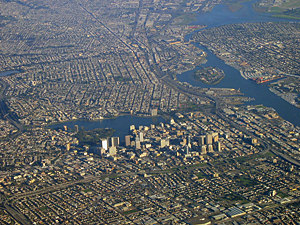
Every weekend that I travel up there, I get to see it from the air if the clouds cooperate. The view from Southwest Airlines is beautiful: I see the lake, and the neighborhoods around, and it always makes me happy.

Monday, June 18, 2007

So, what did you do on summer vacation?


Linda Burnett and I were married in a little ceremony at Temple Sinai in Oakland, CA. The officiants were Rabbis Steven Chester and Jacqueline Mates-Muchin, and the witnesses for the brit ahuvot were Mark Snyder and Dawn Kepler.

Maryann Simpson helped us get organized and dressed, Rabbi David Novak led the sheva brachot at lunch, and guests joined us in giving tzedakah to the Alameda County Community Food Bank as a way of sharing the joy.

Family and close friends were with us, and celebrated afterwards at lunch. It was a great, great day.
From our honeymoon:

THIS was the stop on the trip I had looked forward to the most: Piraeus, Athens, Corinth, and Mycenae. Those are magic words for me: I have loved the Iliad since I was about ten years old.

We arrived in Piraeus, the port city of Athens. Simply bobbing in the harbor there was exciting: this is the port from which the thousand ships launched (Helen's face? Iliad? Trojan War? right.) Nowadays it is full of ferries, freighters, and passenger ships, not triremes and other warships, but still. It didn't take much imagination to be all excited at the idea that this was the very place where Agamemnon sent Clytemnestra into a rage by sacrificing their daughter Iphigenia for a favorable wind.

We had a favorable bus ("21 Purple") and anyway, we were headed inland. Our tour group was a motley crew, including a woman dressed like a ninja (I later found out she suffers from porphyria and cannot tolerate sunlight), several gimpy types like myself (we actually discussed knee replacements -- one woman had had TWO), a Gnostic priest and her honey, a very young couple in camouflage and khaki, and Linda with yours truly. Our tourguide's name was Georgia, and she stepped very gracefully among questions about everything from goddesses to bathroom locations.

Driving out of Athens, we saw the Acropolis from a distance through smog that put L.A. to shame. Granted, it was a rainy, overcast day, but this was impressive smog. The photo I'm posting has been cropped, blown up, and seriously enhanced; I won't waste bandwidth with the original. Still, we can say we saw the Parthenon.

We drove onwards to the next feature, the Corinth Canal. This is a modern wonder, and from an engineering point of view, it truly is a marvelous thing, even if from above it is basically an enormous ditch. It connects the Ionian and Aegean Seas, and makes the Peloponnesian Penninsula into an island. We stopped there and looked at it. We also found a bathroom there, which for a busload of women is another modern engineering marvel worth noting.

We rode for another long while, to intermittent commentary from Georgia about olive trees and ancient politics, until a mountain topped with ruins came into view. "Look up there," said Georgia, pointing. "That is the site of the Corinthian Temple of so-called Aphrodite." Seems the locals actually worshipped a version of the Middle Eastern fertility goddess Astarte, and called her Aphrodite to make it all nice. The Temple was, among other things, an enormous cult brothel, but looking at it, all I could think was that a man had to be awfully determined to get up there. Anything for piety, I suppose!

That acropolis was one reason that Corinth got such a bad name in the ancient world. It was full of sailors and adventurers and cult prostitutes -- no wonder Paul of Tarsus, aka St. Paul, felt the need to lecture the inhabitants on the virtues of agape, or brotherly love! Judging from the ruins, it was also a lovely city. I'll post some photos so you can see what's left of the ancient agora [city center]. The acropolis was not accessible to us (45 min of hard climbing) but the agora was very accessible, and had a museum nearby of artifacts that are still being discovered as they excavate the city.

We made some interesting discoveries there. The city bema was the presidium the big platform on which public speaking was done. I've heard that, but I'd never seen a bema before, and there it is. It happens that this particular bema was the one on which Paul of Tarsus was examined by the Roman authorities after complaints from the local synagogue. We saw bits of the local of the Greek city assembly,synagogue, also: only two small pieces are identifiable, and they were recovered after reuse as parts of other buildings. There is a capital from a column in the museum that has menorot with etrog and lulav, which we spotted almost immediately. There is also an inscription that has the last three letters of the word "synagogue" in Greek along with the first four letters of "Hebrew." According to the guide, that's all that is left of it, and those parts had been recycled as building stone for other, more recent structures.

We saw several bas relief sculptures of a battle between Amazons and Greeks, and beautiful sculptures. All in all, we could have stayed longer, and seen more, but it was time for Mycenae.

We drove some more, and that was when Georgia began to make ominous noises about Mycenae. "We will wait to eat lunch," she said, "It's a very big climb, not good after lunch." Those among us with orthopedic issues sat up and took notice. How much of a climb? Pretty good climb, she assured us. We looked around, and you could feel the resolve hardening in that bus: we'd come to see Agamemnon's city, and by golly, we were gonna see it!

We drove on and on, and Georgia told us about the quarry the archaeologists have found, from which huge stones of the special composite stone were carved for the Lion Gate and the Tomb of Agamemnon. It's miles from Mycenae (since we passed it on the way, we were sure of this) and no one knows how they hauled stones of as much as 100 tons all that distance in the 15th century before the common era. The inhabitants of Mycenae are mysterious to us; they may have been ancestors of modern day Greeks, but nothing is sure.

Finally we saw the double hills that were Heinrich Schliemann's clue that this was indeed the site of Agamemnon's city. Mycenae lies between them, with a view for miles and natural defenses on all sides but one. Approaching, we could see the excavation like a brown scar between the green hills. We parked, descended from the bus, and began the climb up the hill. Georgia was right: it was daunting. I left everything but my camera on the bus and began to put one foot in front of the other, climbing up the path. To our right, archaeologists continued the work of excavation, digging trenches to explore what lay beneath the soil.

The path curved upward to the right, and in the distance, I saw the Lion Gate ahead, looking just as it had in the photos. It is a huge structure, with great lion bodies topping it, a marvel of construction and a work of art. You can see in the photo that it dwarfs the people beneath it. The stones are enormous -- they reminded me of the foundation stones in the lowest levels of the Western Wall in Jerusalem-- and they came from a quarry over ten miles away. This is the only approach to the city, and it is fortified not only with a thick wall, but with daunting psychological defenses: the message is look, we can move these stones, and we will eat you as these lions would eat sheep. Personally, I would not choose to invade this city.

But the gate was open, the Myceneans long gone, so in we went. We saw the grave circle that Schliemann uncovered, not the grave of Agamemnon, as he hoped, but the graves of even earlier kings, wearing golden masks. The gold is all in the museum, and there was not time to visit it, but the graves, to me, were more evocative of the time. What an incredible place! By then, my right leg was screeching at me, but I wasn't sorry I climbed the hill -- it was worth it.

Finally, we visited the Tomb of Agamemnon, also known as the Treasury of Atreus. Both kings had been buried in this great beehive shaped tomb, because after Clytemnestra killed Agamemnon (in his bath!) she had his body unceremoniously put in his father Atreus's tomb. Still, it's pretty darn impressive, a giant human-made hill enclosing a hollow beehive of the mammoth stones from that quarry miles away. The entrance is the only part that photographs well, but as you can see, it is if anything even more impressive than the Lion Gate. The lintel stone (above the door) is the largest stone of all, weighing over 100 tons.

Later we had lunch at a nice place ("Agamemnon's," of course) and took the long bus ride back to the port. We arrived tired, bruised, gimpy, and happy, just in time for the crew of the Veendam to shoo us aboard and pull up the gangway. Then, like the ancient Greek armies, we sailed out of Piraeus and into the sea.

Saturday, February 03, 2007

I love to bake bread.

Yes, I know, in a traditional mode, one does not bake bread on Shabbat. One bakes challah on yom shishi [Friday] but one does not bake on Shabbat.

My understanding of Shabbat, though, is that it is a day different from all other days, a day of rest, a taste of olam habah [the world to come], a day for enjoyment and family. And it is the one day of the week I bake. My sweetie and I spend Shabbat afternoon sitting in the warm kitchen, gradually assembling a nice soup, shmoozing with family and friends, smooching if family and friends don't show up, and I make bread.

Once upon a time, about 30 years ago, I made all the bread for my family. Breadmaking was sanity, health, and love. Now I do other things (perhaps saner things?) for sanity, health, and love, but on Shabbat afternoon, I love to bake a loaf of bread. Not challah -- usually a double measure of bread, one loaf of plain and one of whatever suits my fancy that day. Meanwhile a soup of odds and ends and leftovers and canned tomatoes simmers on the stove, and the door is open to whoever appears.

In difficult times, Shabbat keeps us going. For me, right now, the loaves of bread rising in the warm spot near the cooktop speak of the miracle of yeast that comes back from dry deadness, the elasticity of love.

Thursday, January 04, 2007

I'm entering the home stretch of my rabbinical school years. The last year or so I've not posted so much, because frankly, I thought that the fine details of halakhah and ethics courses would be less than spellbinding reading for my friends and family.

I have the last third of my internship ahead of me in the coming term, 125 hours at the Jewish Home for the Aging in Reseda, CA. I love that work very much: I feel like I'm making a real contribution and it includes the bonus of meeting fascinating people and hearing their stories.

My coursework is winding down. I'm meeting tomorrow with the Registrar at HUC to go over my transcript and make sure nothing is lacking, but as it stands now, I'll take a couple of courses this spring, and have only a tiny bit left for the fall. People have been asking me all through this process what could possibly take five or six years, and now I have the transcript to answer that question.

The big project on the horizon is my rabbinical thesis, and I'm completely at sea on that one. I hope to have some news in the near future, but for now it consists of ongoing conversations with several faculty members.

Increasingly, I miss my home up in Oakland. My sons are moving on in their lives: the "baby" who started college when I started HUC now holds a B.A. in Psychology from UC Santa Cruz. His older brother is out in the working world, full of plans and building a life. A couple of years back I reconnected with an old sweetheart, someone who'd been my friend for the 15 years since we went separate ways, and we're planning a wedding in May. Wherever "home" will be after my ordination in May 2008 (b'ezrat Hashem!) right now it is with the people I love, and they are all 400 miles north of Los Angeles, along with many dear friends.

I've just overhauled the template for this site, since Blogger.com offered some new possibilities. Welcome to 2007; I wonder what it will bring?

Wednesday, December 06, 2006

My friend Emily DeVoto has a marvelous blog, The Antidote: Counterspin for Health Care and Health News. It is exactly what it sounds like, a critical take on health and health care news. On Nov 30 she posted something that I thought I'd pass along: Something's Fishy.

The gist of it is that while it's good for our health to eat fish, some fish are being over-fished for their survival. That hardly seems fair, and beyond fairness, long term it could be really bad news. Her blog entry includes a PDF with a neat little fold-out thingie for your shopping bag that tells you which fish are your best buy from a survival point of view (ours and theirs.)

The good news, as far as I'm concerned, is that anchovies are still on the menu. I realize that may not thrill everyone, but I'm happy. Sardines are good, as is carp. The "big three," shrimp, tuna, and salmon, are more problematic (for more info, read her post and the PDF.)

Monday, November 13, 2006

It has taken a week for the news from last week's election to sink in: we are going to have a Democratic Congress. I thought I'd be ecstatic if that happened, but now I find I'm just sort of tired and cautiously optimistic.

There is so much to do to repair the damage of the last five years, and I do not envy the new Congress that has to do it. The national budget is hemorrhaging of red ink, Iraq is Terrorism Central, we have (in the words of Colin Powell) "broken it and bought it," and still the bodies keep piling up in Baghdad. The rest of the Middle East is festering, our allies are looking at us sideways, wondering if we can be trusted, and we've repudiated the Geneva Conventions, for crying out loud. Meanwhile our ports are vulnerable to attack, but my eye drops never go near the airport without a Ziplock baggie.

The world hasn't felt this dangerous to me since I knelt with the rest of the second graders in the hall at Overbrook School, praying that God would keep Castro from firing off those nukes at Miami. The difference is that this time I feel like we've mostly done this to ourselves.

Yeah, yeah, yeah, I know: terrorists. Even there, I'm sorry, I am not going to let my government off the hook: why didn't we hunt down Al Qaeda when we had them cornered in Afghanistan? Why did we squander every bit of the international goodwill after 9/11 on this stupid mess in Iraq? Why was Iraq deemed more important than the real threat of nukes in Iran and North Korea? Why have we run this so-called "war" without any sacrifices at home, with tax cuts and lattes all around?

And why, why, why do we keep calling the terrorists "jihadists" which is, to their ears, like calling them "the guys in the white hats"? Do our news media and our government not understand that when we do that, we are affirming that yes, indeed, we're the Great Satan?

Augh.

As for me, I am still praying. This time I'm praying for Nancy Pelosi and the other new leaders we've elected, praying that they will be wise and prudent and will not blow their precious political capital on dumb stuff like revenge. I'm praying that they will find a way out of these various messes. I'm praying that they can hang onto their souls while they do it.

In the meantime, I shall get back to my homework.

Saturday, November 11, 2006


It's Motsei Shabbat -- the evening after Shabbat -- and I am enjoying the afterglow of a lovely day. I attended services today at Temple Beth Sholom in San Leandro, CA. Behind the large 60's synagogue is the tiny "Little Shul" from the 1890's. It is a haimish [homey] little place, and I felt instantly comfortable there.

Rabbi Harry Manhoff presided, but most of the service was led by a young woman from the congregation, and the Torah was chanted by several adults from the shul's Hebrew program. Very impressive!

The rest of the day was spent eating good food and chatting with friends at home. What could be more perfect?

Sunday, October 29, 2006

In "Freakoutonomics," in the current issue of The New Republic, Jonathan Chait writes:

"Over the last quarter century, the portion of the national income accruing to the richest 1 percent of Americans has doubled. The share going to the richest one-tenth of 1 percent has tripled, and the share going to the richest one-hundredth of 1 percent has quadrupled."

This is serious, serious stuff and I recommend the entire article. Income inequality in this country has grown steadily in the past few years, and the rate of increase has skyrocketed recently. Chait points out that one of the ways we see this is in the economic dissatisfactions of the middle class: despite the fine performance of the economy on paper, those gains have gone to the most privileged in our country. Meanwhile, the poor have gotten poorer, and the middle class have gotten nowhere at all, and prices have done what prices do in a roaring economy -- they've gone up.

Another item I recommend: Sophia Coppola's Marie Antoinette. It's an interesting view of the woman and the time: the ferment in the streets of Paris is visible only on the margins, an occasional downbeat reference almost lost in the sybaritic consumption, opulence, and sheer silliness of Versailles. The opening scene says it all in shorthand: a servant tends to Marie's toes while she languorously drags a finger through the icing on a cake.

Marie knows that she is a woman whose primary function is as a symbol and a womb: she is there to cement a bit of realpolitik and to bear heirs for the Bourbons. In the meantime, she is free to enjoy herself within the rules of the Versailles court, which means that the only part of her that enjoys much freedom is her purse. Goodies insue, until the revolution comes and the party is over. The movie ends then, allowing the viewer to contemplate the situation without the distractions of the prison and the guillotine.

I've seen some interviews in which Coppola says that she was interested in the idea of the teen monarchs, able to do as they like. Maybe so, but the movie also stands for me as a warning to those of us who enjoy prosperity in days that are not prosperous for everyone.

Marie Antoinette never said, "Let them eat cake." The movie and several other accounts portray her as a nice party girl who did the charitable things expected of her, and who shopped and consumed for fun. She loved her family, was a good mother, and was not much sillier than anyone else around her. A generation earlier, we might not remember her at all. We remember her and her luckless family because they didn't realize that privileges can be revoked until it was too late.

In a country where "
the share going to the richest one-hundredth of 1 percent has quadrupled," we cannot afford to be so blinkered. Wake up, America: get your fingers out of the cake -- smell the republic burning.


Saturday, October 28, 2006

I have put some new materials up on the website: this week's Torah study and Hebrew lesson, a guide to saying and writing blessings, and a poem connected with the Nachamu, Nachamu exhibit.
This Wednesday, Nov. 1, the exhibition "Nachamu, Nachamu: The Heavens Spread Out Like a Prayer Shawl" will open at Hebrew Union College in Los Angeles, CA. I had the privilege of being one of the rabbinical students in the midrash class that participated in the process with the artist, Victor Raphael, and the further privilege of introducing the artist and part of the work at the school's Opening Day, on August 20, 1996.

This is the speech that I gave that day, and the picture to the right is one small part of the installation in Room 105. If you are in or near Los Angeles, I strongly recommend you come to HUC and see Victor's work; it is transcendant.

----------------------------------

What do you get when you combine one teacher of midrash, eleven rabbinical students, and a world-class multimedia artist?

Or

How do you put windows into an HUC classroom without blowing holes in the wall?

The answers to those questions lie behind the copper-clad door of Room 105.

Last year eleven unsuspecting students signed up for a one term class on “Homeletical Midrashim” taught by Dr. Lewis Barth. We did not know that we were embarking on what would become a year-long project, indeed, that four members of the class would be ordained before the work was complete.

The class studied the 16th Pesikhta of the Pesikhta de Rav Kahana, a 5th c. collection of midrashim. Pesikta #16 is a homily on the haftarah for Shabbat Nachamu, “Nachamu, Nachamu Ami” [Comfort, Comfort My people]. About two weeks into the course, Dr. Barth told us that this was not an ordinary midrash class. Donors Nancy Berman and Alan Bloch had offered HUC the commission of a work of art. Our task was to learn Pesikta #16, and then teach it to an artist named Victor Raphael. He would then create an interpretation of the midrash, a major work of art, for permanent installation at HUC Los Angeles.

In the process, we learned and taught midrash, but we also learned about the nuts and bolts of working with an artist on a commission from an institution. Victor came to our class to teach us about his work process, a fascinating multimedia journey involving digital photography, computer-based techniques and hand-painting in gold and metal leaf. We made a presentation at the Bloch and Berman home, to teach the midrash to them and to Victor, following with a discussion of the structure and imagery of the homily.

Some months after the class was officially over, we met again with Victor to see the work in progress and to help with some of the decisions about the artwork. Victor, Dr. Barth, and our class met with Dax Clark to look at the project from the point of view of building maintenance issues.

Over this time, the initial “work of art” became instead an installation that would, we hoped, transform one of our HUC classrooms into a space for sacred study. Another anonymous donor made it possible to upgrade the lighting and the wall-covering.

This midrash class was an education for all of us. It is our hope that the result of all this work is a worshipful study space, a room that offers comfort and inspiration for both teachers and students. The images are grounded in Jewish texts, and they emerged from a conversation among many different members of the Los Angeles Jewish community: Nancy Berman, Dean Barth, our class, Victor Raphael, Dax Clark, and others.

The title of the work is,

“Nachamu, Nachamu: The Heavens Spread Out Like a Prayer Shawl.”

Now, I would like to introduce the artist who has carried out this remarkable work, who worked with us so patiently and generously: the artist Victor Raphael:

Victor was born and raised in California, earning a B.A. from the University of California, Los Angeles. His artwork has been collected by numerous private and public institutions, including the Bibliothèque Nationale, Paris, and the Los Angeles County Museum of Art, and exhibited internationally, from Denmark’s Museet for Fotokunst to Tokyo’s Metropolitan Museum of Photography.

Please welcome our artist, our friend, our companion, and teacher, Victor Raphael.